In short
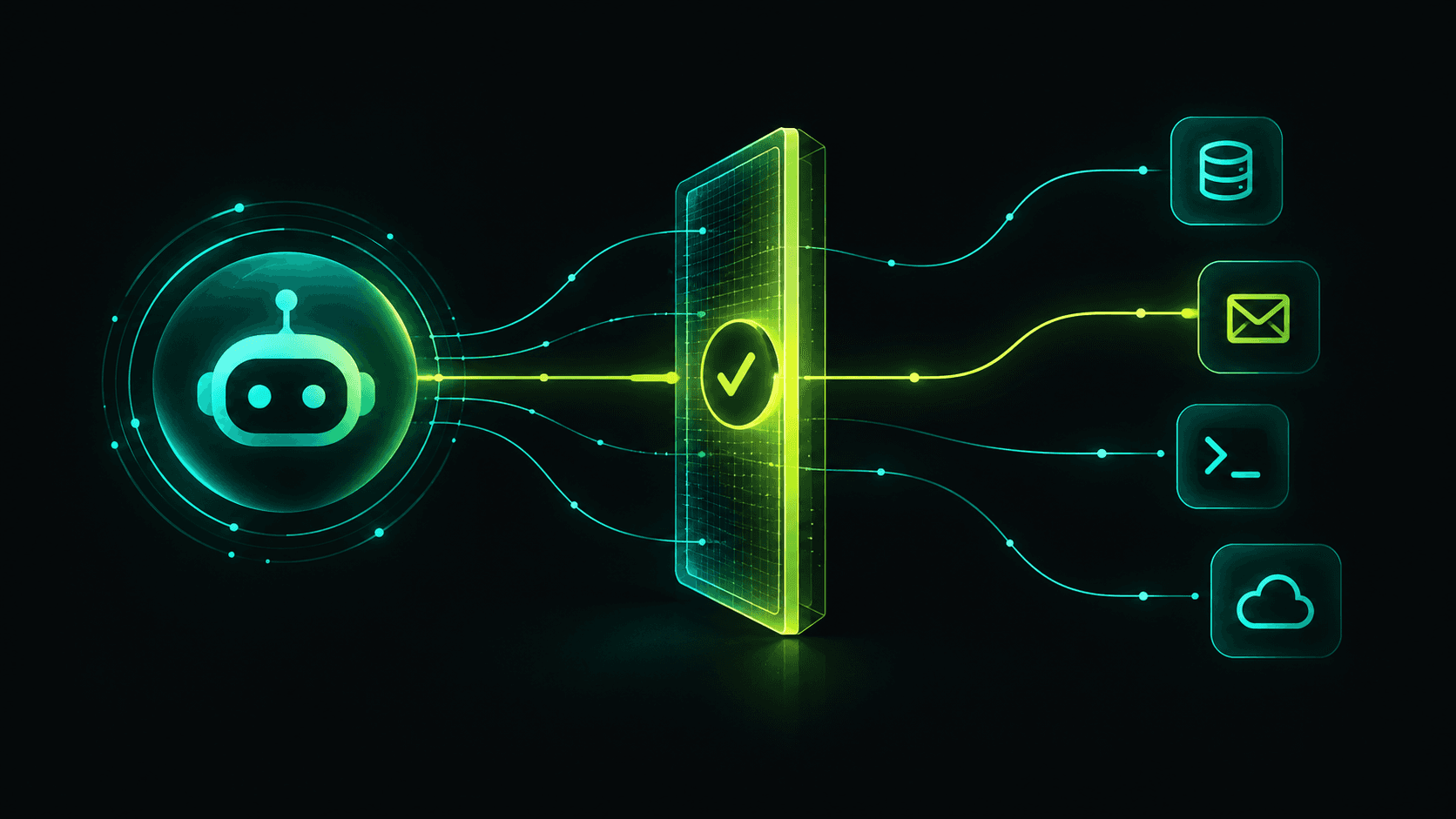
AI agent authorization is the practice of deciding, before an AI agent's action executes, whether that specific action should happen. A policy evaluates which agent is acting, on whose behalf, what it wants to do and against which system, then allows it, holds it for human approval or denies it.
Key points
- Agents act, not just answer: their mistakes become changes in real systems.
- Identity, network controls and prompt filters don't decide whether a specific action should run.
- Authorization adds an explicit decision before execution: allow, hold or deny.
- It needs agent identity, security-owned policy, human approval, short-lived access and an audit trail.
- The control works best outside the agent stack, so every agent follows one policy.
The line between answering and acting
An assistant that writes a paragraph can be wrong, but it cannot deploy the wrong build. The moment an agent gets credentials to a cloud account, a billing system or an internal API, its mistakes and its compromises stop being text on a screen and start being state changes in your infrastructure.
What makes agents different from classic automation isn't just access - it's discretion. A script does what it was written to do. An agent reasons about a goal, chooses tools and composes actions nobody explicitly wrote down. You can review a script before it ships. You cannot review a decision an agent hasn't made yet.
Why existing controls miss it
Most of the security stack answers a different question than the one agents raise. Identity and access management answers who can connect. Network controls answer what can reach what. Prompt filters answer what the model may say. None of them answer the question that actually matters once an agent holds credentials: should this specific action, by this specific agent, on this specific system, happen right now?
Give an agent a service account and every control upstream of the action says yes by default. The agent is authenticated. The network path is allowed. The prompt looked fine. And then the action executes - whatever it is.
Authorization as a decision, not a filter
Agent action authorization puts an explicit decision between the agent and the system it wants to touch. Before a sensitive action executes, something in the request path resolves four things: which agent is acting, on whose behalf, what exactly it wants to do and against which target - then evaluates policy and produces one of three outcomes: the action is allowed, it waits for a person to approve it or it is denied.
The important property is that this is a decision with a reason, made before execution, by rules a security team wrote - not a heuristic the agent can talk its way around and not an alert someone reads after the fact.
The pieces that make it work
Identity for agents. Authorization is meaningless if you can't tell who is asking. An agent action should be attributable to an agent, the workload it runs in and the human principal it acts for. "Unknown workload" should be a denial, not a shrug.
Policy owned by security. What needs approval is written down - by agent, action, target and context. The agent doesn't decide whether its own action is sensitive, for the same reason a process doesn't sign its own code.
Human approval at the boundary. Some actions should always pause for a person: production deploys, large refunds, data exports. The action waits - held, not executed - until someone accountable releases it.
Scoped, short-lived access. The safest credential is one that exists only because a specific action was authorized, can do only that action and expires in minutes. Standing keys turn every agent bug into a standing risk.
An audit trail of decisions. Not a model transcript - an authorization history. What was requested, what was decided, under which policy, who approved it, what actually ran. That's what incident response and compliance actually need.
Where the control should live
The control has to be independent of the agents it governs. If every agent framework ships its own guardrails, you get as many security models as you have frameworks - each maintained by the team with the least incentive to say no. An authorization layer that sits outside the agent stack gives you one policy, one decision point and one audit trail across everything: internal agents, frameworks, MCP servers and vendor agents alike.
That is the layer Zeta Cortex builds. Agents keep their autonomy. Your systems keep a boundary. And every action - allowed, held or denied - is accountable.