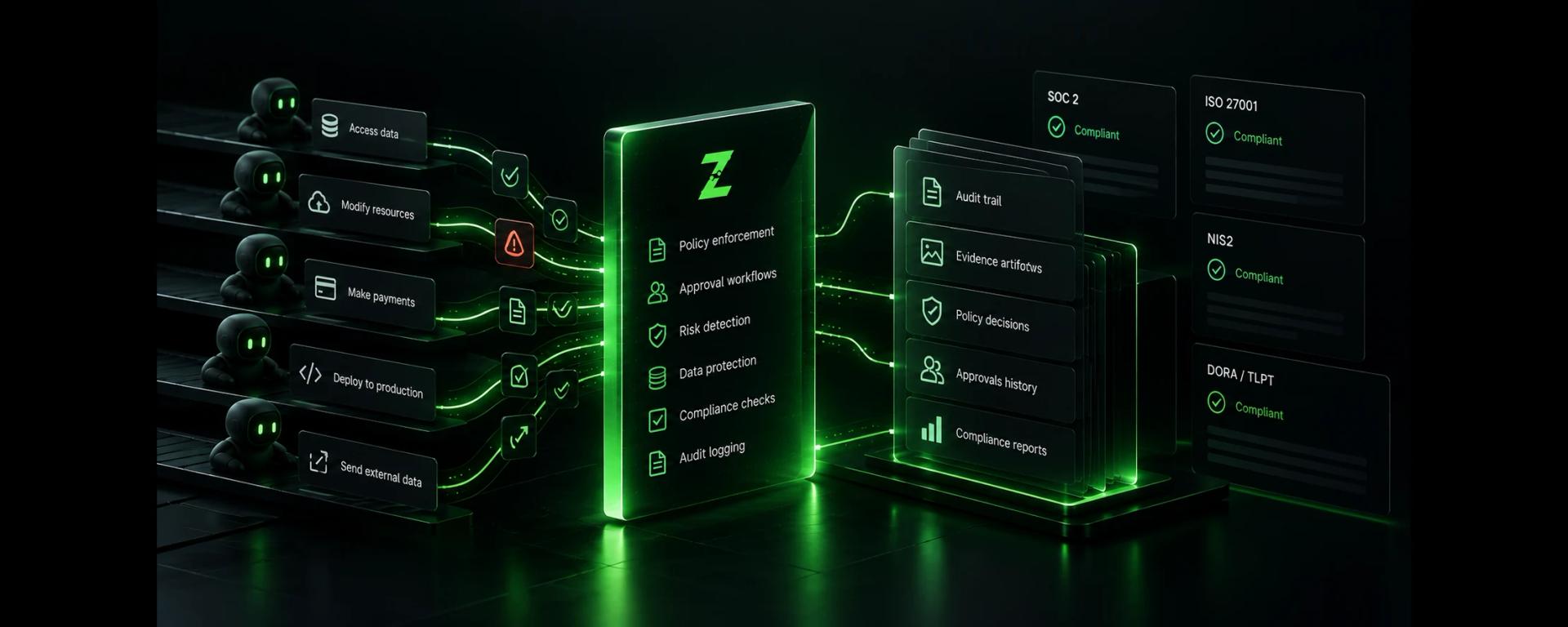
Say yes to agents.
Keep the control.
Security keeps the policy, the approvals and the evidence.
100%
Of agent decisions logged with policy and reason
1
Policy set enforced across every agent
0
Standing credentials left with agents
5min
Default lifetime of a scoped credential
Built for what a review actually asks for
Not a dashboard for its own sake - the specifics an audit, an incident or a regulator's question turns on.
Framework-shaped evidence
The oversight the EU AI Act and NIST AI RMF ask about - who acted, under which rule, with whose sign-off - falls out of normal operation.
Incident forensics
Trace a suspicious action from request to execution in minutes, with every decision along the way attributed.
Separation of duties
The teams building agents don't grant their authority. That stays with you, by construction.
Per-environment rules
Staging stays cheap to experiment in while production keeps the strict set - without two codebases of guardrails.
Every action reaches a landing
Every action an agent takes stops here first, then continues, waits for a person or turns back.
Read a customer record for a ticket
In policy, and recorded
Export the full customer list
Waits for the data owner
Turn off audit logging
Stopped and flagged to security
“Agents should move fast. Their actions shouldn't go unchecked.”
Why one control layer beats many guardrails
Each agent framework ships its own safety settings. A security team can't review, prove or maintain all of them.

One policy for every agent
Internal, vendor and framework-built agents all pass the same rules, instead of one guardrail per tool.
Prevention, not alerts
Risky actions are stopped or held before they execute, rather than flagged in a log the morning after.
Rules people can read
Policies are written so reviewers and auditors can understand them, not buried inside agent code.
New use cases without new exceptions
Each new agent doesn't need its own security exception negotiated from scratch.
Not ready for a pilot? Get early access instead.